Saturday, July 31, 2010
PCI-E SSD? Um, maybe, maybe not.
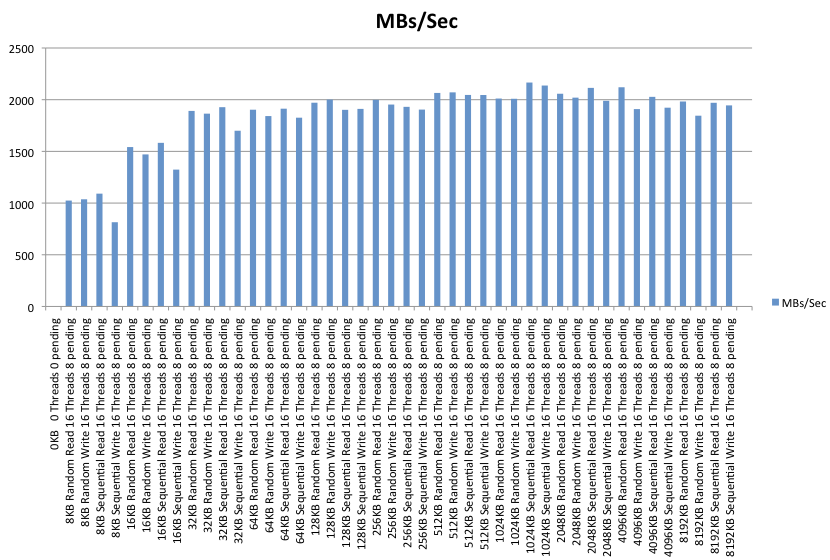
After further testing, the OCZ Z-Drive seems to choke when pushed to 8 & 16 threads. My future Oracle servers will be pushing 32 threads, and having my storage choking out is not an option. I know the RAID controller in the R910 can feed the CPU's easily. Now I am pondering on 14x OWC SSD's in RAID10, with the 2 remaining disk slots housing 146GB 15k SaS disks in Raid1 for the Linux OS and Oracle_Home. I'm wondering what kinda IOPS and performance 14 of those in RAID10 will attain. Maybe it's time to "test" that theory out. The OWC disks have a full 5-year warranty and use the new Sandforce controller. Hmmm..... Maybe handing those 14 disks to ASM would be best. Yes, it's time for more testing. OCZ is out of the picture now. It's a prosumer product purporting to be an enterprise product. Pushing past 2 simultaneous threads revealed that as truth in my eyes. A wise man once said "Truth is treason in the empire of lies."


Thursday, July 29, 2010
Interesting concept: Blocking entire continents.
Now this is a very interesting concept. If you do business only in the US, this could be useful in further securing your network. If you run your own Exchange server, this could even tremendously lower your incoming spam volume at your network point of access (firewall). If you host on your own webserver, this could easily further secure it. Face it, the vast majority of security breaches and spam originate from outside of the US, and if you don't communicate with people or do business with people outside of the US, why allow any connections from those countries?
I give you the link: http://www.countryipblocks.net/continents/
I may investigate this further for our own use.
I give you the link: http://www.countryipblocks.net/continents/
I may investigate this further for our own use.
Error: 0xC03A001D "The sector size of the physical disk on which the virtual disk resides is not supported."
Hyper-V, why art thou so persnickety? My storage performs best with 4k sector sizes, yet YOU demand 512byte sectors and upchuck this nastily huge error message and fail to boot my VM. For reference, this is only a ~300GB LUN.



Wednesday, July 28, 2010
Tuesday, July 27, 2010
SSD and Spindle Disks
Traditional spindle-based SAN will be going out to pasture in the HPC/Oracle/SQL/Virtualization market segments within the next 5 years. It only takes two $400 SSD's to totally decimate 15x SATA disks costing ~$20k. The big storage vendors would be well advised to "get with the program" and soon. Guys like Texas Memory Systems, Violin, Whiptail, and Fusion IO are exploding in those markets today and will even more as NAND prices drop. Buy'em before someone else does or they get too big to be acquired is what I would do if I were EMC or Netapp, or even Dell/HP/IBM. EMC's Enterprise Flash Disk (EFD) is a running joke to those "in the know" in the storage game.
To put this into perspective, today I tested a little svelte Sony VAIO VPC-Z1190X extremely portable laptop with an i7 Quad-core CPU, 8GB of RAM, with 2x 250gb factory SSD's in RAID0. Right out of the box, it was brutally fast. I setup a VMWare Player VM running XP Pro SP3 with 2x processors, and 4GB of RAM. 2 Virtual Disks of 30GB and 60GB. The 30GB disk housed the OS and Oracle 10g R2 installation with our applications. The second disk housed the actual database files. I imported one of our QA schemas into the local instance. This local Oracle instance was allocated 2GB of physical RAM. I setup our applications as usual on the same primary disk.
I ran a few processes in our apps utilizing the local Oracle instance and it ran circles around our QA database server. I shook my head in amazement. A VM running Oracle outperformed our PRIMARY QA database server by a LONG shot.
Our primary QA database server's specs:
Dell PowerEdge 1955 Blade, 2x 3.2GHZ Xeon CPU's, 8GB of RAM, 2x local 300GB 10k SCSI disks.
The first disk houses the OS Installation (Windows Server 2003 R2 STD, 32bit) and the pagefile.
The second disk contains the Oracle installation (ORACLE_HOME to those of you who know what it means). Oracle only uses 2GB of RAM because it is a 32-bit OS and application.
There is a 2-port Qlogic 2gb Fibre Channel HBA connecting to an EMC Clariion with 12x 500GB 7200rpm SATA disks in RAID10. Networking is handled via 2x Intel 1Gb/s ethernet links using NIC teaming and link aggregation in the switch side.
Yes, this "piddly" little laptop costing ~$4k totally running a 32-bit VM smokes this blade server with fibre channel SAN attached. It is amazing how far technology has come in the past few years, and I can't help but smile knowing it will only get better over the next few years.
Monday, July 26, 2010
Virtualization is a wonderful thing.
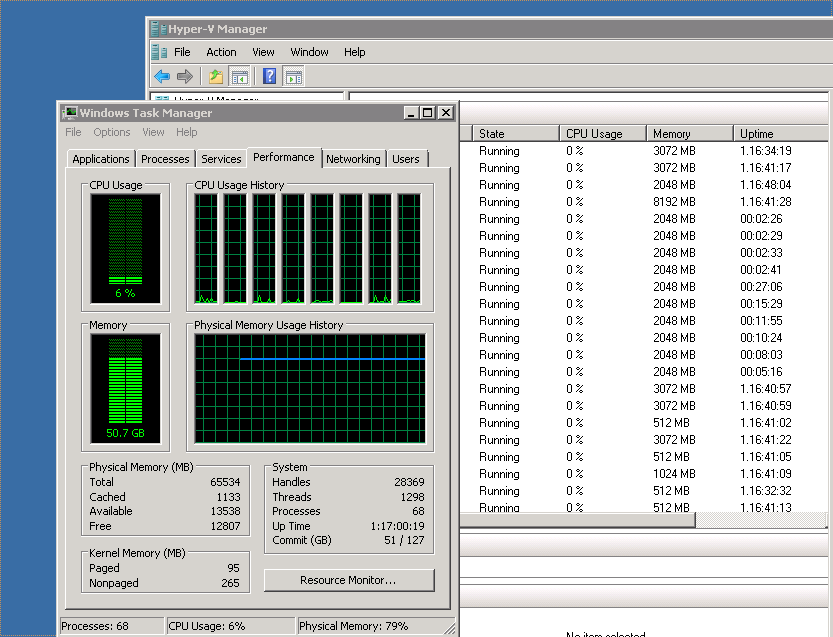
22 virtual servers running on one host, not even breaking a sweat in the process.

Subscribe to:
Posts (Atom)